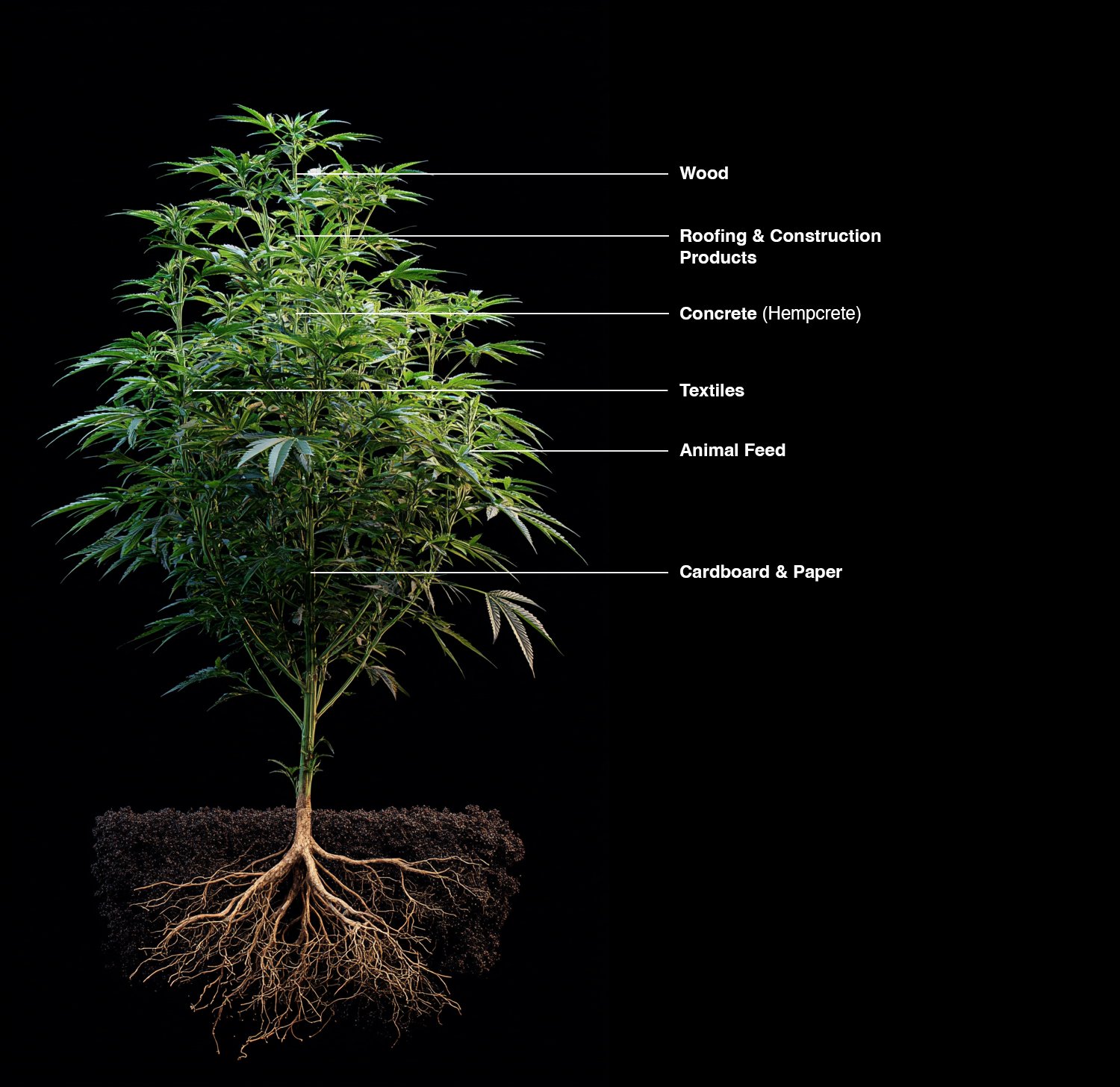
Hemp's versatility spans many industries, offering renewable materials that reduce environmental impact without depleting forests or ecosystems. Hemp fiber can be recycled up to eight times — compared to about three for wood — resulting in a much longer useful life for the material.
Hemp seeds, oil, hurd, fiber, and meal each feed a different downstream supply chain. That diversity is what makes hemp economically resilient: a single rotation can serve multiple end markets, and a single grower's harvest doesn't depend on any one buyer.
These hemp-derived solutions can reduce reliance on synthetic chemicals and support healthier fields and soils — the same crop that yields fiber for fabric or hurd for hempcrete also rebuilds the soil under it.
Hemp reaches maturity in months rather than decades. When engineered into solid materials, it matches the hardness of white oak.
Lime + hemp hurd creates a carbon-negative building material with excellent thermal mass and breathability.
One acre of hemp yields the fiber equivalent of 4-10 acres of timber, regrowing in a single season.
Durable, breathable, and softer with each wash — used in everything from workwear to luxury fabrics.
Hemp meal is high in protein and omega-3s, with applications in poultry, livestock, and aquaculture.
Hemp seed oil substitutes for linseed in industrial coatings, with comparable durability and a lower carbon footprint.